
Story by Tu-Uyen Tran, the Forum of Fargo-Moorhead, Dec. 22, 2017, Front Page
WEST FARGO — Donors who stop at Christine Schmidt's red Salvation Army kettle often like to share a friendly word or two, she said as she rang bells with her mother Lorie at the Cash Wise grocery store here Thursday, Dec. 21.
She'll chat, she said, but she also likes to sneak a peek to see what they're putting in the kettle, aware that sometimes people donate unusual things, such as gold coins. "It's kind of exciting. It's pretty cool that someone would give that up."
It's not easy to spot these donors who have been spreading their generosity anonymously for 18 years in Fargo-Moorhead. The most recent donor managed to sneak a gold Krugerrand worth about $1,300 in the kettle here at this grocery store more than a week ago, on Dec. 12.
Still, the Salvation Army does have a small clue who some donors might be because they sometimes call to let the charity know to search a certain kettle, said Maj. Elaine Medlock, who runs the organization here.

Story and photos by Tu-Uyen Tran, the Forum of Fargo-Moorhead, Oct. 21, 2017, Front Page
HUNTER, N.D. — Growing up, Donald Aune would hear stories from his mother about the sod house she lived in as a child in the late 1800s near Milton, N.D.
She talked about how cozy it was despite the harsh prairie winters and how hard it was to keep clean; it was made of dirt, he said.
One day, a man with a camera stopped by to document the house and the family, Aune's grandparents, John and Marget Bakken, his uncle and his mother. To many Americans the house has become a symbol of the Homestead Act that opened up land in the West for thousands of pioneers like the Bakken family. The photo was later used by a Treasury Department artist in a 1962 U.S. postage stamp commemorating the centennial of the law.
But, for Aune, who now lives in Hunter, the Bakkens' story didn't start with that sod house on the prairie and it didn't end there either.
Story by Tu-Uyen Tran, the Forum of Fargo-Moorhead, July 9, 2017, Front Page
FARGO — Even after many decades, Denise Peterson could vividly remember the auto accident she saw when she was about 12 during a family road trip along U.S. Highway 81.
"There was blood, and I still could see grandma with her white hair in a bun on the back of her head, holding her broken false teeth in her lap," Peterson said. It was probably around the late 1960s, she said, and she was old enough to understand from her parents' conversation that "this was a very busy and dangerous road."
U.S. 81 was then the Red River Valley's main north-south route but, like many U.S. highways of the time, had not kept up with the growing number of vehicles. The solution to that traffic problem was under construction not far west. Like nearly all other superhighways, Interstate 29 was designed for high-speed travel with four lanes and no at-grade crossings.
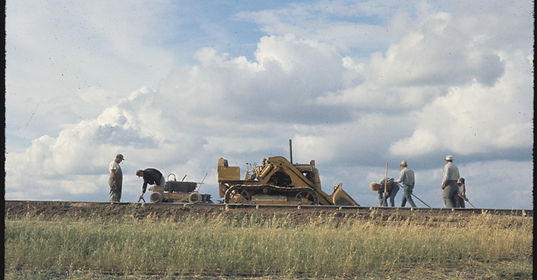
This year is the 40th anniversary of the completion of the Interstate Highway System in North Dakota. Here, as in many places around the country, the interstate system was layered on top of other road networks that had come before, including the prototype for the highways cobbled together from rude country roads by early automobile enthusiasts.

Story by Tu-Uyen Tran, the Forum of Fargo-Moorhead, June 03, 2016, Front Page
FARGO, N.D. – Crofton Coves is one of many subdivisions in Fargo-Moorhead with names that don’t match their geography, such as Fargo’s South Beach Townhomes or West Fargo’s Brooks Harbor – a name that will soon grace the city’s new elementary school. It’s not a trend isolated to the area. Home builders all over want to remind homebuyers of elsewhere.
Why? Part of it is marketing but, mostly, developers just like to have a little fun.